Ice Shooting Minneapolis Today Video and The Shooting in Minnesota
A fatal shooting involving a U.S. Customs and Border Protection (CBP) agent in Minneapolis early Saturday morning has intensified already simmering tensions in the city, drawing sharp criticism from state leaders, provoking angry protests, and raising fresh questions about the expanding presence of federal law enforcement in Minnesota.
According to federal officials, the incident occurred when a CBP agent shot and killed an armed individual during an encounter with U.S. Border Patrol officers. The shooting unfolded against the backdrop of nearly daily protests in the Twin Cities, fueled by anger over immigration enforcement operations and the recent killing of another Minnesota resident by a federal officer.
As details emerged, the event quickly became a flashpoint one that encapsulates broader debates over public safety, federal authority, accountability, and community trust.
Contents
A Deadly Encounter in Broad Daylight
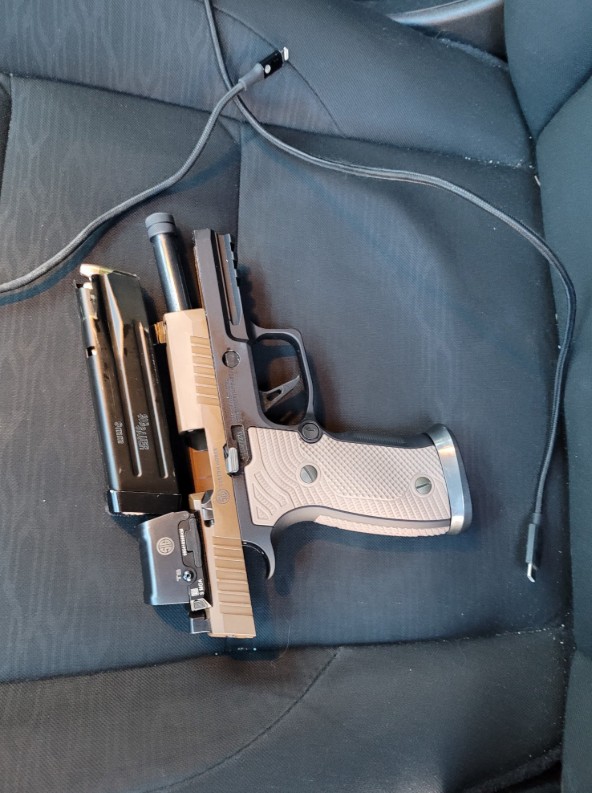
The Department of Homeland Security (DHS) confirmed that the shooting took place Saturday morning in Minneapolis. In a brief statement, the agency said an individual approached U.S. Border Patrol officers while armed with a 9mm semi-automatic handgun.
The Ice Shooting Minneapolis Today Full Video in Minnesota
Federal officials claimed that officers attempted to disarm the individual, but the suspect “violently resisted.” According to DHS, the situation escalated rapidly, leaving one agent fearing for his life and the safety of fellow officers.
“Fearing for his life and the lives and safety of fellow officers, an agent fired defensive shots,” the statement said.
The individual was pronounced dead at the scene. Authorities did not immediately release the person’s identity, and it remained unclear whether family members had been notified.
DHS also released a photograph of the handgun the individual was allegedly carrying, a move often used by law enforcement agencies to support claims of imminent threat during use-of-force incidents.
Witnesses Describe Chaos and Shock
While federal officials framed the shooting as a necessary act of self-defense, witnesses described a chaotic and deeply unsettling scene.
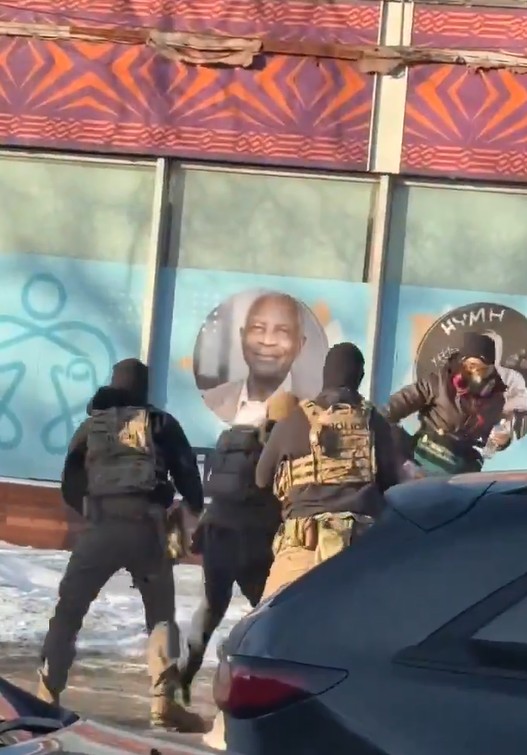
A worker at a nearby business told ABC News that they witnessed the shooting and were “currently dealing with the fallout.” The individual described shock and fear, noting that the area quickly became overwhelmed by emergency responders, law enforcement vehicles, and distraught bystanders.
For local workers and residents, the shooting was not just another headline it unfolded steps away from their daily routines, reinforcing a sense that violence has become an inescapable part of life in parts of the city.
City and State Officials Respond
The city of Minneapolis acknowledged the shooting in a post on X, stating that officials were looking into reports of a shooting involving federal officers near West 26th Street and Nicollet Avenue.
Minnesota Governor Tim Walz issued a far more forceful response.
Walz said he spoke with the President following the shooting and expressed deep frustration with the ongoing federal law enforcement operations in the state.
“Minnesota has had it. This is sickening,” Walz said in a statement. “The President must end this operation. Pull the thousands of violent, untrained officers out of Minnesota. Now.”
His remarks reflected growing anger among state leaders who argue that federal immigration enforcement tactics are destabilizing communities rather than improving public safety.
Anger Erupts at the Scene
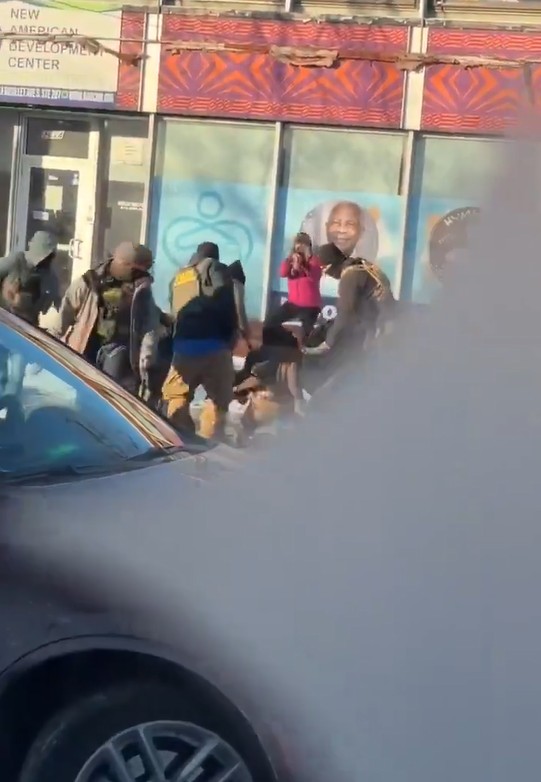
Shortly after the shooting, crowds of bystanders and protesters gathered near the location, many shouting profanities at federal officers and accusing them of cowardice. Some demonstrators repeatedly told the officers to “go home,” expressing fury at what they view as an occupying federal force operating without local consent.
Tensions escalated as federal agents remained on scene. According to eyewitnesses, officers deployed tear gas to push protesters back, filling the air with chemical irritants and further inflaming the crowd.
In one moment that quickly spread on social media, an officer was seen responding mockingly to protesters as he walked away, telling them, “Boo hoo.” Elsewhere, agents shoved a yelling protester into a vehicle, intensifying accusations of excessive force and disrespect toward civilians.
The Minnesota State Patrol later issued a warning, declaring the gathering an “unlawful assembly” and ordering the crowd to disperse. Despite the heightened confrontation, there were no immediate reports of arrests.
A City Already on Edge
The shooting did not occur in isolation. Minneapolis and the surrounding Twin Cities region have been the site of widespread protests for weeks, driven largely by outrage over the January 7 killing of 37-year-old Renee Good.
Good was fatally shot when an Immigration and Customs Enforcement (ICE) officer fired into her vehicle, an incident that reignited painful memories of past police killings and galvanized public opposition to federal law enforcement activity in the area.
Since then, protests have taken place nearly every day, with demonstrators calling for ICE and other federal agencies to leave Minnesota entirely. Just one day before Saturday’s shooting, thousands of people flooded Minneapolis streets in frigid winter weather, chanting against immigration crackdowns and demanding accountability.
For many residents, Saturday’s fatal shooting confirmed their worst fears that increased federal enforcement would lead to more violence, not less.
Federal Presence Under Scrutiny
CBP and ICE traditionally operate near U.S. borders, but in recent years, their presence has expanded deeper into the country. Supporters argue that these agencies are essential to enforcing immigration law and combating organized crime. Critics counter that their growing role in interior cities undermines local authority and escalates tensions.
Governor Walz’s accusation that federal officers are “violent” and “untrained” echoes concerns raised by civil rights groups, community activists, and some local officials. They argue that federal agents often operate with limited oversight and unclear rules of engagement when interacting with civilians far from the border.
Saturday’s shooting has intensified calls for transparency, particularly regarding training standards, use-of-force policies, and coordination with local law enforcement.
Unanswered Questions
As of Saturday, many critical questions remained unanswered.
Authorities had not released the identity of the person killed, nor clarified why Border Patrol officers were operating in that specific area of Minneapolis. It was also unclear whether body-worn camera footage exists or whether it would be made public.
Federal investigations into officer-involved shootings can take months, and critics worry that delays or lack of transparency could further erode public trust.
Community leaders have also questioned whether de-escalation tactics were fully employed and whether lethal force was truly unavoidable.
The Human Cost
Beyond politics and policy debates, the shooting represents another life lost and another community traumatized.
Local businesses were disrupted, residents were shaken, and families both of the deceased individual and of those living nearby were left grappling with fear and uncertainty.
For Minneapolis, a city that has spent years trying to rebuild trust between law enforcement and communities after high-profile police killings, the presence of federal officers using deadly force has reopened old wounds.
A Breaking Point for Minneapolis
Saturday’s deadly encounter underscores how volatile the situation in Minneapolis has become. With protests continuing, political leaders openly clashing with federal authorities, and residents increasingly divided, the city appears to be at a breaking point.
Whether the federal government will respond to Governor Walz’s demands remains to be seen. What is clear is that without meaningful dialogue, transparency, and accountability, tensions are likely to escalate further.
For many Minnesotans, the question is no longer whether something must change but how many more lives will be lost before it does.
Hot News -Hot Springs Arkansas Fight Video and Circle K Fight Full
Tom Garratt Video and What Everyone Is Talking About
Nainai Jumping Video and A Livestream Farewell
Maddie Kowalski Video and UF Florida Student at Eiffel Tower
Masjid Bandar Lampung Full Video No Blur and CCTV Footage
Yera Shower Video and Social Media Impact
Ghost Rider Cartel Video and Understanding the Origins